We were given 10MB of static webpages with BT Internet and three CGI scripts with BTInternet.
This has shaped my journey.
We needed a boat booking system for the sailing club. At the time there was a paper diary and you phoned the owner of the diary. http://www.dougrice.plus.com/
So we could learn about writing HTML and uploading the page over a dial-up modem at 56K.
Try and record what is simple and what is more complex.
What features require more complexity.
I have thought I need to write down for myself a path through the journey.
A web page written in pure HTML can be written using a simple text editor and opened using a Web Browser.
Learning HTML requires documentation which, at the time was in books from a bookshop.
I had dialup, but it used the phone line, needed a phone call and prevented incoming calls.
Images probably needed to be scanned from photos.
Microsoft provided Frontpage express, and website authors were using Dreamweaver
BT Internet did not allow user written CGI scripts. It had a cgi script for visits counter, guestbook, and form to email.
I worked out that if the guestbook saved the data from form fields wrapped in JavaScript? Function calls, I could include the JavaScript? and process the data. This would save a lot of learning in the short turn.
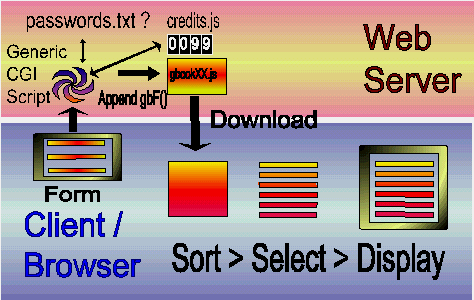
Generic CGI script wraps Form data in gbF().
function gbF( name, email, postedOn, IPaddress, userfield1, userfield2, userfield3, userfield4, comments)
Include remote guestbook and gbF() will be called once per entry.
I could run Appache on my PC using fixed IP addresses.
https://imatix-legacy.github.io/xitami/25b4/
Web hostering was evolving
This was accessed using DialUp?, it was before CPANEL so you needed to find a tool to FTP your files to to the live server. As you were using a penny per minute dialup, it was best to not develop on the live server.
Leaning HTML requires a lot of skills
Using subst w: simplifies URL usage when opening .htm files saved from the server and opened off the desktop, if they include href=/js or src=/img
At the times Styles were inline and it was pre CSS.
A study of the HTML exported by Microsoft Word required a mass of bloat.
It was before CSS and the HTML seemed to use P tags and SPAN tags and loads of styles .
I am still looking for a tools that produced the minimum HTML for a nice looking page. This wiki helps.
CSS was another thing to learn. Amists the mass of other worries, The syntax was lost on me
 style=" color:red; "
 class=name   needs    .name
 id=name  needs #name
Using HTML DIV tags with CSS was worth learning.
I started with Forms and used name= and associated JavaScript?
JavaScript? and Forms:-
  // pict up the data from the assorted file and fill in the update form.
   var F1 = window.document.forms["F1"]
   // This is picked up from a cookie
   F1.name.value       =  cookieA[ 'name'  ]
   F1.email.value      =  cookieA[ 'email' ]
F1.userfield1.value = record.userfield1
JavaScript? and ID:-
id=
document.getElementById?( "label"+label );
JavaScript? on a webpage is a useful tool to try out programming ideas. It provided a workaround to running unapproved .exe files tools on my PC for work.
Using Dial up means Client Side is simpler.
Serverside needs a Webserver. I could run one on my home PC
Now I can use PHP -S to start up a local web server
Early on you could use frames to to form the panels of a web page. Frame have been depreciated.
So you could have a title and links panel, and a panel for each subject page.
HTML does not support Client Side includes, where you can include blocks of HTML. I used JavaScript? for this.
JavaScript? could be used for writting HTML and outputting it as the page was loaded.
Later on InnerHTML? allowed bits of a webpage to be updated.
You could write CGI scripts using Perl and PHP.
Learning and remembering the syntax for appending variables in PERL, PHP, ASP, JAVASCRIPT, AWK , C adds complexity
There is a need to tabulate all of this.
PHP allows Server Side include files so it would be possble to write pages that have standard headers.
You can convert an HTML file to PHP by changing the extension, but you then need to run it from the webserver.
BT Internet did not allow PHP scripts.
I could write CGI scripts in Perl, but not on BT Internet.
Plusnet provided a CGI server.
You could PHP and CGI on the CGI server.
PHP -S now starts a development server.
A web page using frames could load multiple HTM files and update the subject and provide client side global variables, which are a security risk.
| title banner |
| menu panel |
| subject panel |
| footer panel |
HTML webpages cannot do Client side include for HTML, but can include JavaScript? to output the same HTML on multiple pages. JavaScript? now supports multi-line strings closer to the HTML layout.
PHP and PERL allow multi-line strings
PHP and PERL supports server side include, so that common code can be used on multiple pages.
![[Home]](../ipstats.gif)