Ultratec Textphones have Acoustic Couplers. WebAudio can squark and listen. Earbuds provide transducers, and milk bottle tops help.
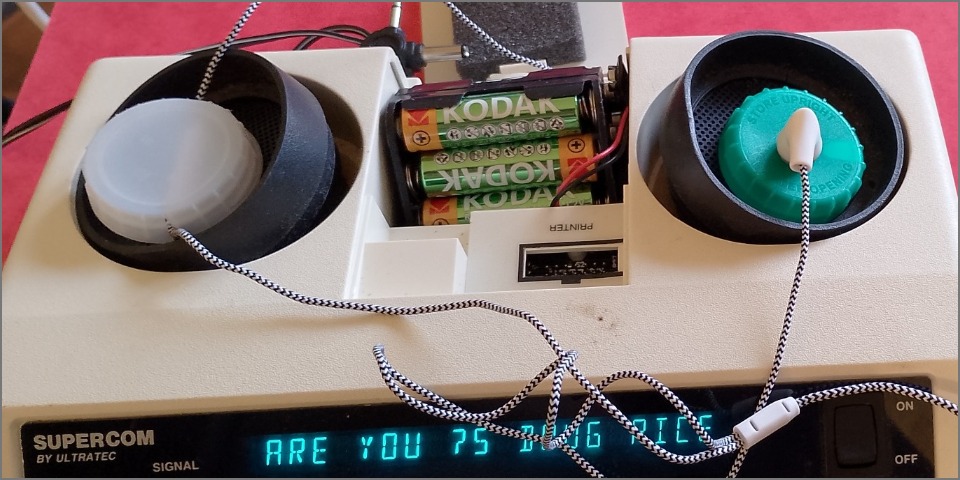
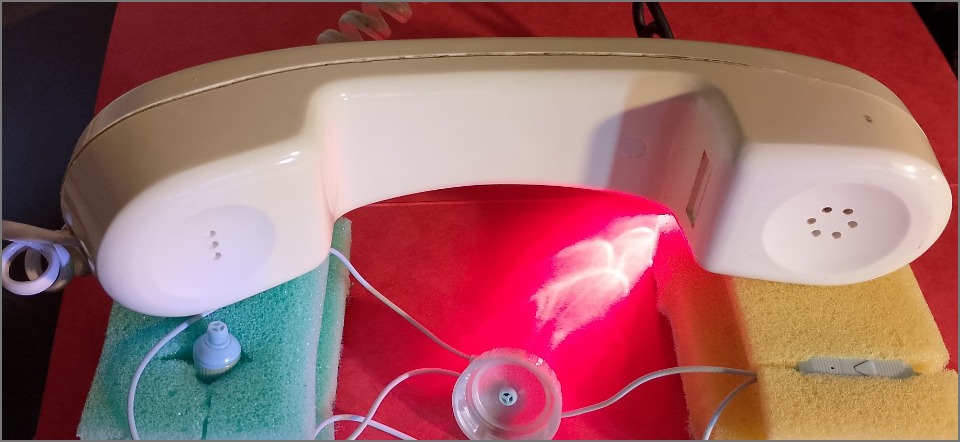
Here is a proof of concept Acoustic Coupler using two washing up sponges to hold the transducers in place.
https://www.dougrice.co.uk/cgi-bin/wiki.pl?Textphones
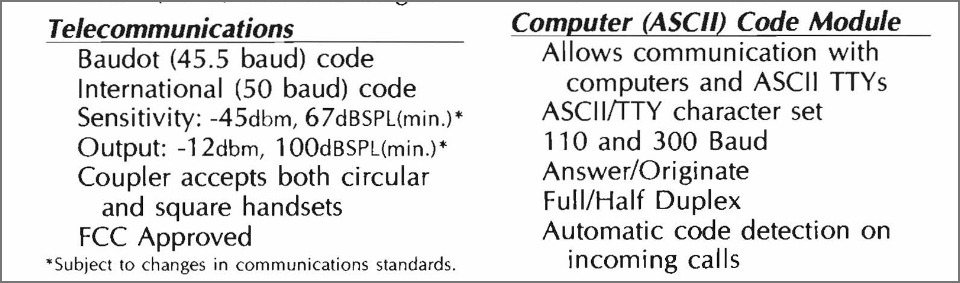
https://www.ultratec.com/support/ lists a number of models. Over the years the list of modems supported has changed a lot. ITU V.18 is an attempt to work out how to interwork the various textphones used around the world.
https://www.relayuk.bt.com/how-to-use-relay-uk/use-relay-uk-with-textphone.html
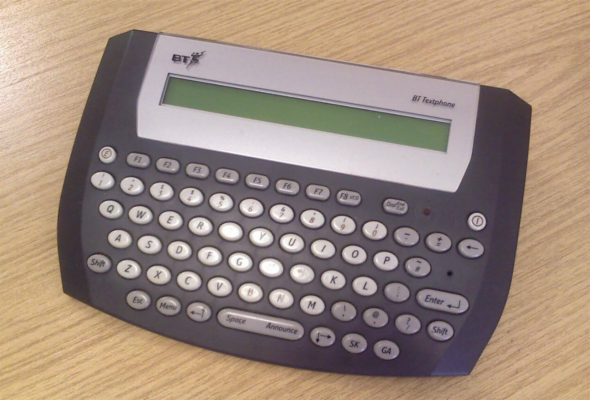
The textphones were different and ITU V.18 lists six modems. From:- https://www.discapnet.es/innovacion/productos-de-apoyo/terminales-de-texto-para-personas-con-discapacidad-auditiva
The most commonly used text terminals for deaf people are:
Not all text phones use and or support all of them. Some support a selection. Some have options not listed in ITU V.18
| Modem | mode | Mark | Space | Baud Rates | notes |
| BAUDOT | HALF-DUPLEX | 1400Hz | 1800Hz | 50 / 45.45 | |
| DTMF | HALF-DUPLEX | N/A | N/A | N/A | sends letters using * # ending with a digit |
| EDT | HALF-DUPLEX | 980 | 1180 | 110 | |
| V.21(orig) | Duplex | 980 | 1180 | 300 | sends CT or CI |
| V.21(ans ) | Duplex | 1650 | 1850 | 300 | ANS sends carrier |
| Bell 103 (orig) | Duplex | 1270 | 1070 | 300 | |
| Bell 103 (Answ) | Duplex | 2225 | 2025 | 300 | |
| V.23 (orig) | Duplex | 390Hz | 450Hz | 75 | |
| V.23 (Answ) | Duplex | 1300Hz | 2100Hz | 1200 | |
| VOICE conversation | SIMPLEX | 300Hz | 3400Hz | N/A | |
| VOICE conversation | HALF-DUPLEX | 300Hz | 3400Hz | N/A | |
| VOICE 2-wire | DUPLEX | 300Hz | 3400Hz | N/A |
| ULTRATEC TURBO | HALF-DUPLEX | 1400Hz | 1800Hz | bit length not constant | |
| V.21(orig) | Duplex | 980 | 1180 | 110 | on my Ultratec Supercom and Superprint 100 |
| V.21(ans ) | Duplex | 1650 | 1850 | 110 | on my Ultratec Supercom |
Hopefully a common mode can be found.
Modes like EDT, BAUDOT, DTMF only send carrier for a short period before and after a character is typed.
Modes like V.21 wait for carrier from the remote end before "user" traffic can be sent.
When V.21 ( originate ) sets up against V.21(answer) , it waits for ANS(2100Hz) and Carrier from the Answering end.
The sending end should not send "user" traffic until CD is ON. The originating end can send CT or ITU V.8 CI, probing for ANS(2100Hz) and Carrier.
This was confirmed by sending ATD and ATA commands to a USB modem that uses AT commands. A command to disable "hangup on loss of carrier" was send. The ATA and ATD commands could be sent. The first ATD
V.18 sends CI in short bursts, short enough so that the CD pin remains off.
CD remains OFF until Carrier is present see ITU V.21 TABLE 2/V.21 Note2 for long enough. It needs a "front porch" of MARK before text can be sent.
http://www.dougrice.plus.com/dev/UART/UART2_V.18_generators.htm can be used to generate signals which the Textphone responds to.
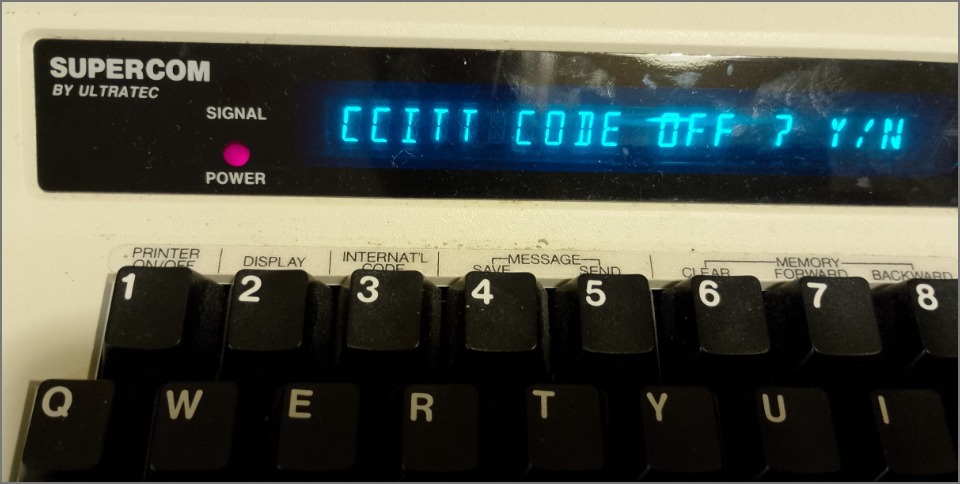
My Ultratec COMPACT and Supercom set to CCITT can confirms this. The audio does not chirp when a key is pressed, if it is not receiving MARK from the other end.
When CODE is set to CCITT ANSWER, it emits carrier tone.
Textphones - notes on text phones
Modems - notes on modems and the names of signals on RS-232 cables
Around the world many different solutions to TYPE and READ textphones evolved.
ITU V.18 tries to workout how to get them and Relay Services to interwork.